13 Apr 2026
Understanding Exercise Forces: A Practical Guide to Lever Mechanics in the Gym
The Force Diagram Explained Simply
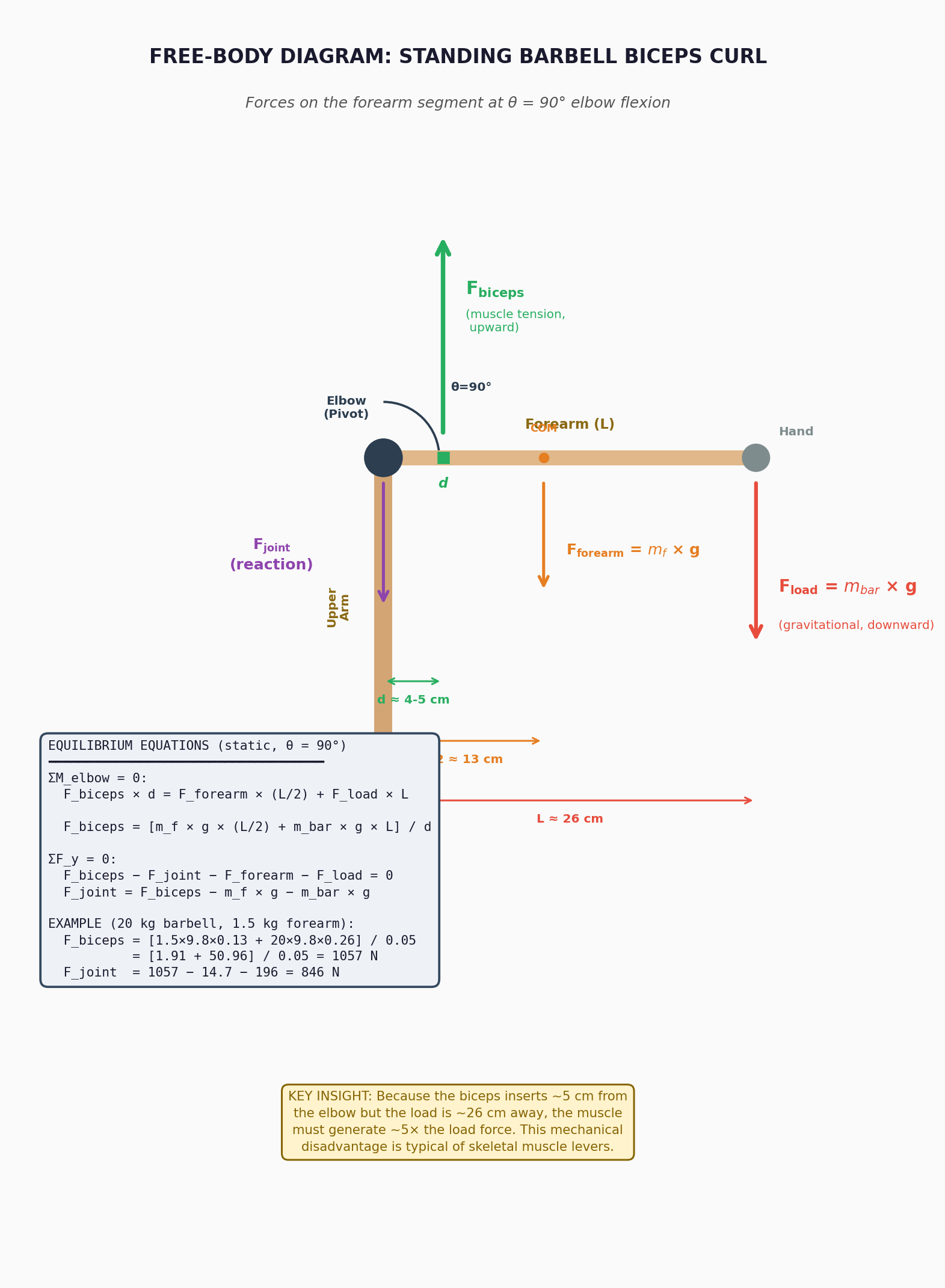
Look at the biceps curl force diagram as a seesaw. Your elbow is the fulcrum (the middle of the seesaw), your biceps muscle pulls up very close to the elbow, and the barbell pulls down way out at your hand.
The Core Idea: Your Muscles Work Way Harder Than You Think
Imagine a seesaw where a child sits 1 foot from the center and needs to lift an adult sitting 5 feet from the center. The child has to push much harder because of the distance disadvantage. That's exactly what your muscles deal with every rep.
- Your biceps attaches only ~5 cm from the elbow
- The weight is ~26 cm away at your hand
- So the muscle has to generate roughly 5x the weight you're holding just to move it
A 20 kg barbell doesn't feel like "just" 20 kg to your biceps — it's experiencing over 1,000 N of tension internally.
Three Things That Change the Force on a Muscle
1. The Angle of the Joint (θ)
At the bottom of a curl (arm straight), the torque on the biceps is almost zero. At 90° (forearm horizontal), torque is maximum because gravity has its longest "lever" against you. That's why the middle of a curl feels hardest — it is hardest, physically.
2. The Distance from Joint to Load (the Lever Arm)
The farther the weight is from the joint, the harder the muscle works. This is why front raises (arm extended, weight far from shoulder) are brutally hard with light dumbbells, while shrugs (weight hanging straight down through the joint) let you move much heavier loads.
3. The Direction of Gravity Relative to the Movement
Gravity only pulls straight down. If you're pushing in the same line as gravity (like the top of an overhead press), the muscle is fully loaded. If you're moving perpendicular to gravity (like the top of a fly where the dumbbells are directly above you), the muscle is barely loaded — that's a "dead spot."
How to Use This in the Gym
Maximize Tension Through More of the Range of Motion
Cable machines and bands keep tension constant because the resistance direction tracks your movement, unlike free weights where gravity only pulls down. A cable curl loads the biceps evenly from bottom to top. A dumbbell curl has a dead spot at the top and bottom.
Match the Resistance Curve to the Muscle
Muscles are weakest at full stretch and full contraction, and strongest in the mid-range. Chains and bands added to barbells make the weight heavier as you reach the stronger part of the range — matching physics to biology.
Grip Width and Stance Width Shift Muscle Recruitment
A wide grip curl forces a wider angle at the elbow, changing the line of pull to emphasize the inner (short) head of the biceps. Narrow grip shifts it to the outer (long) head. Same weight, same joint, different muscle fiber recruitment — just by changing the lever geometry.
Compound Movements Load More Muscles Simultaneously
Multiple joints acting as levers at once means more total muscle work per minute:
- A squat uses the hip, knee, and ankle as three simultaneous pivot points. Your quads, glutes, hamstrings, and erectors are all generating torque at their respective joints at the same time. One exercise, multiple lever systems, more total muscle work per minute.
- Contrast that with a leg extension, which only uses the knee as a pivot — it isolates the quads but leaves the other muscles idle.
Maximizing Gym Time: Strategy Summary
| Strategy | Why (physics) | Examples |
|---|---|---|
| Use multiple joints as levers | More muscles loaded per rep | Squats, deadlifts, rows, presses |
| Keep the load far from the joint | Higher torque = more muscle tension | Lateral raises, front raises, Romanian deadlifts |
| Maintain tension through full ROM | No "dead spots" where muscles unload | Cables, bands, incline curls |
| Use angles that maximize gravitational torque | Gravity works hardest when the lever arm is horizontal | Incline curls (stretches biceps under load), preacher curls (removes cheating) |
The Simple Rule
The muscle works hardest when the weight is farthest from the joint and the limb is perpendicular to gravity.
Every time you choose an exercise, set an incline angle, or pick a grip width, you're really choosing where the lever advantage sits. Understanding this lets you pick fewer exercises that create more mechanical tension — which is the primary driver of muscle growth — instead of doing more sets of less effective movements.
Generated from analysis of 1,619 exercises in relabeled_magic_excel_20260412.xlsx.